WAGYU MASTER PRODUCT GUIDE JAPANESE WAGYU CUTS
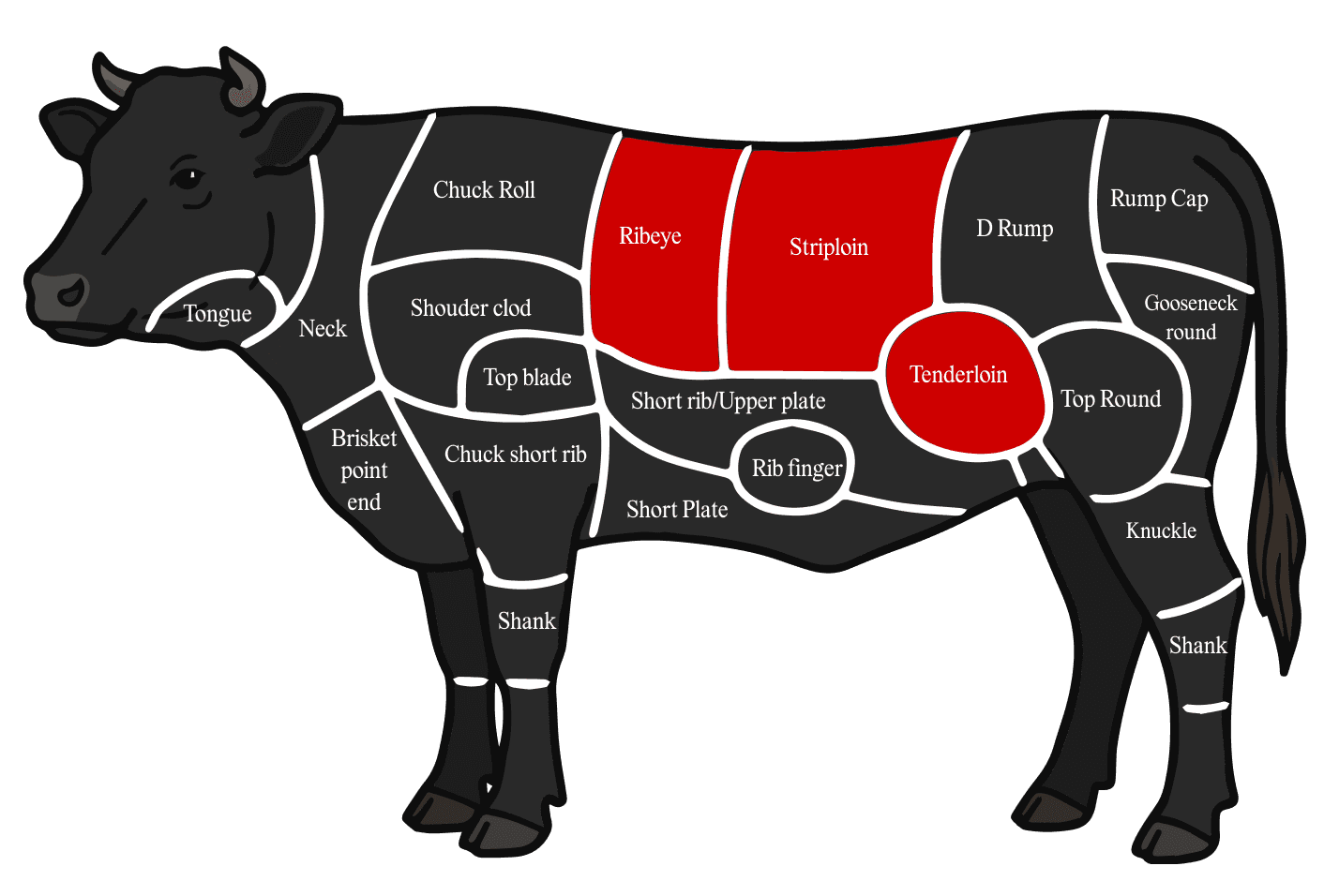
To provide B2B partners, restaurants, chefs, and consumers with the most comprehensive, accurate, and practical understanding of Japanese Wagyu beef products, Wagyu Master has developed the Handbook of Wagyu Product, based on the classification system of 4 Major Primal Cuts, in accordance with the standards of the JMGA, JLEC and international trade practices, comprising:
FOREQUARTER (Forequarter / まえ - Mae): A flavorful area rich in natural connective tissue and home to a variety of distinctive Rare cuts.
LOIN (Loin / ロイン - Roin): The most premium and valuable area, offering exceptional tenderness and the highest density of finely distributed marbled fat (Shimofuri).
SHORT PLATE & BRISKET (Short Plate & Brisket / ばら - Bara): An area where lean meat and fat are perfectly interwoven, delivering a characteristic rich, juicy, and buttery flavor.
ROUND (Round / もも - Momo): A lean red-meat (Akami) area, rich in nutrients, with a naturally sweet, clean, and delicate beef flavor.
※ Starting from the original 4 major primal cuts, Wagyu Master applies a technical butchery and separation process (based on the official Japanese Wagyu Beef Cutting Guide by JLEC) to standardize them into 14 major sections (sub-primal cut), followed by further trimming, deboning, and block cutting to create a total of 31 standard Wagyu Cuts.
This cutting classification is based on the official Japanese Wagyu Beef Cutting Guide published by Japan Livestock Products Export Promotion Council (JLEC).
From these cuts, Wagyu Master has developed 15 core commercial product categories (including Striploin, Ribeye, Tenderloin, Top Blade, Chuck Roll, Chuck Flap, Set Short Plate, Set Knuckle, Set Rump, etc.). The supply format is designed to flexibly meet the needs of both whole blocks for restaurants and chefs and pre-cut Retail Portions for home dining, across the full range of Wagyu A5, A4, and F1 grades.
HANDBOOK | WAGYU MASTER PRODUCT GUIDE



Main Cuts: Chuck Roll (肩ロース - Katarosu), Shoulder Clod (カタ/ウデ - Kata/Ude), Neck (ネック - Nekku), Point End Brisket (かたばら/マエバラ - Katabara/Maebara), and Shank (スネ - Sune).
Meat Characteristics:
※ As these are load-bearing and highly active muscle groups, the meat is firm, with resilient muscle fibers and a high content of natural connective tissue/collagen.
※ In Japanese Wagyu, this area still features finely distributed marbling (Shimofuri), creating a harmonious balance between rich beef flavor and natural sweetness and richness.
※ It can be further divided into numerous high-quality Rare cuts with exceptional tenderness, comparable to premium loin cuts, such as Misuji (Top Blade), Zabuton (Chuck Flap), and Sankaku Bara (Chuck Rib).
Recommended Dishes:
※ Sukiyaki & Shabu-shabu: Particularly suitable when thinly sliced from Chuck Roll (Katarosu), Misuji, or Kata.
※ Yakiniku / BBQ & Steak: Recommended for richly marbled cuts such as Sankaku Bara (Jo-Karubi), Zabuton, Misuji, or Chuck Eye Log.
※ Slow-cooked Dishes / Curry / Soup & Ground Beef (Hamburg / Meatballs): Ideal for Neck, Sune (Shank), and Pectoral/Brisket, as the connective tissue gradually breaks down into soft, flavorful gelatin during prolonged cooking.
Main Cuts: Ribeye / Ribloin (リブロース - Riburosu), Striploin / Sirloin (サーロイン - Saroin), and Tenderloin / Fillet (ヒレ/ヘレ - Hire).
Characteristics:
※ Located along the back and loin of the animal, this area consists of muscles that undergo very little movement throughout the animal's life.
※ This is one of the most premium and valuable areas of a Wagyu carcass.
※ The meat has a fine texture, exceptional tenderness, and a dense distribution of finely interwoven marbling (Shimofuri). When heated, Wagyu fat melts and releases a rich, buttery aroma reminiscent of fresh butter and ripe coconut (Wagyu-ko).
Recommended Dishes:
※ Premium Steak (Steak / Filet Mignon / Chateaubriand): Sear over high heat and enjoy Rare to Medium-Rare to fully appreciate its tenderness and juiciness.
※ Yakiniku / Yaki-shabu / BBQ: Cut into medium-thick or thin slices for quick grilling over high heat.
※ Sukiyaki & Shabu-shabu: Slice to 1.5-2 mm so the marbled fat blends harmoniously into the broth.
※ Roast Beef: Roast as a whole block to retain the natural juiciness inside.
Main Cuts: Chuck Roll (肩ロース - Katarosu), Shoulder Clod (カタ/ウデ - Kata/Ude), Neck (ネック - Nekku), Point End Brisket (かたばら/マエバラ - Katabara/Maebara), and Shank (スネ - Sune).
Meat Characteristics:
※ As these are load-bearing and highly active muscle groups, the meat is firm, with resilient muscle fibers and a high content of natural connective tissue/collagen.
※ In Japanese Wagyu, this area still features finely distributed marbling (Shimofuri), creating a harmonious balance between rich beef flavor and natural sweetness and richness.
※ It can be further divided into numerous high-quality Rare cuts with exceptional tenderness, comparable to premium loin cuts, such as Misuji (Top Blade), Zabuton (Chuck Flap), and Sankaku Bara (Chuck Rib).
Recommended Dishes:
※ Sukiyaki & Shabu-shabu: Particularly suitable when thinly sliced from Chuck Roll (Katarosu), Misuji, or Kata.
※ Yakiniku / BBQ & Steak: Recommended for richly marbled cuts such as Sankaku Bara (Jo-Karubi), Zabuton, Misuji, or Chuck Eye Log.
※ Slow-cooked Dishes / Curry / Soup & Ground Beef (Hamburg / Meatballs): Ideal for Neck, Sune (Shank), and Pectoral/Brisket, as the connective tissue gradually breaks down into soft, flavorful gelatin during prolonged cooking.
Main Cuts: Ribeye / Ribloin (リブロース - Riburosu), Striploin / Sirloin (サーロイン - Saroin), and Tenderloin / Fillet (ヒレ/ヘレ - Hire).
Characteristics:
※ Located along the back and loin of the animal, this area consists of muscles that undergo very little movement throughout the animal's life.
※ This is one of the most premium and valuable areas of a Wagyu carcass.
※ The meat has a fine texture, exceptional tenderness, and a dense distribution of finely interwoven marbling (Shimofuri). When heated, Wagyu fat melts and releases a rich, buttery aroma reminiscent of fresh butter and ripe coconut (Wagyu-ko).
Recommended Dishes:
※ Premium Steak (Steak / Filet Mignon / Chateaubriand): Sear over high heat and enjoy Rare to Medium-Rare to fully appreciate its tenderness and juiciness.
※ Yakiniku / Yaki-shabu / BBQ: Cut into medium-thick or thin slices for quick grilling over high heat.
※ Sukiyaki & Shabu-shabu: Slice to 1.5-2 mm so the marbled fat blends harmoniously into the broth.
※ Roast Beef: Roast as a whole block to retain the natural juiciness inside.
SUB-PRIMAL CUT
※ Starting from the original 4 major primal cuts, Wagyu Master applies a technical butchery and separation process (based on the official Japanese Wagyu Beef Cutting Guide by JLEC) to standardize them into 14 major sections, followed by further trimming, deboning, and block cutting to create a total of 31 standard Wagyu Cuts.

Characteristics:
※ Location & Anatomy: Positioned in the upper forequarter between the neck (Neck) and the ribloin (Ribeye), spanning from the 1st to the 6th thoracic vertebrae (cut perpendicular to the dorsal line, spanning 6 ribs under Japanese Wagyu specifications).
※ Muscle Structure: A large primal cut comprised of distinct sub-muscle groups, including the Chuck Eye Log (Katarosu-shin), Chuck Flap/Chuck Flat (Zabuton), and Rib Cap (Kaburi).
※ Texture & Marbling: Combines generous, fine marbling with the deep umami flavor of lean meat, offering a tender texture and collagen-rich connective tissue that renders into rich gelatin when heated.
※ Versatility & Value: Highly cost-effective primal cut that can be separated into various sub-cuts or sliced thinly, allowing restaurants to expand menu variations at flexible price points.
Recommended Dishes:
※ Sukiyaki: Paper-thin slices simmered in a sweet-savory broth, highlighting the harmonious balance between rich marbled fat and deep beef flavor.
※ Shabu-shabu: Thinly sliced and swished briefly in hot broth for a tender mouthfeel with sweet, melting fat.
※ Steak (Chuck Eye / Zabuton Steak): Thick-cut steaks carved from the Chuck Eye Log or Zabuton, pan-seared to medium-rare for a juicy, full-bodied bite.
※ Yakiniku / Barbecue & Stewing: Sliced for quick charcoal grilling (Yakiniku/BBQ) or slow-cooked in stews/curries to dissolve connective tissue into rich, savory sauce.
Characteristics:
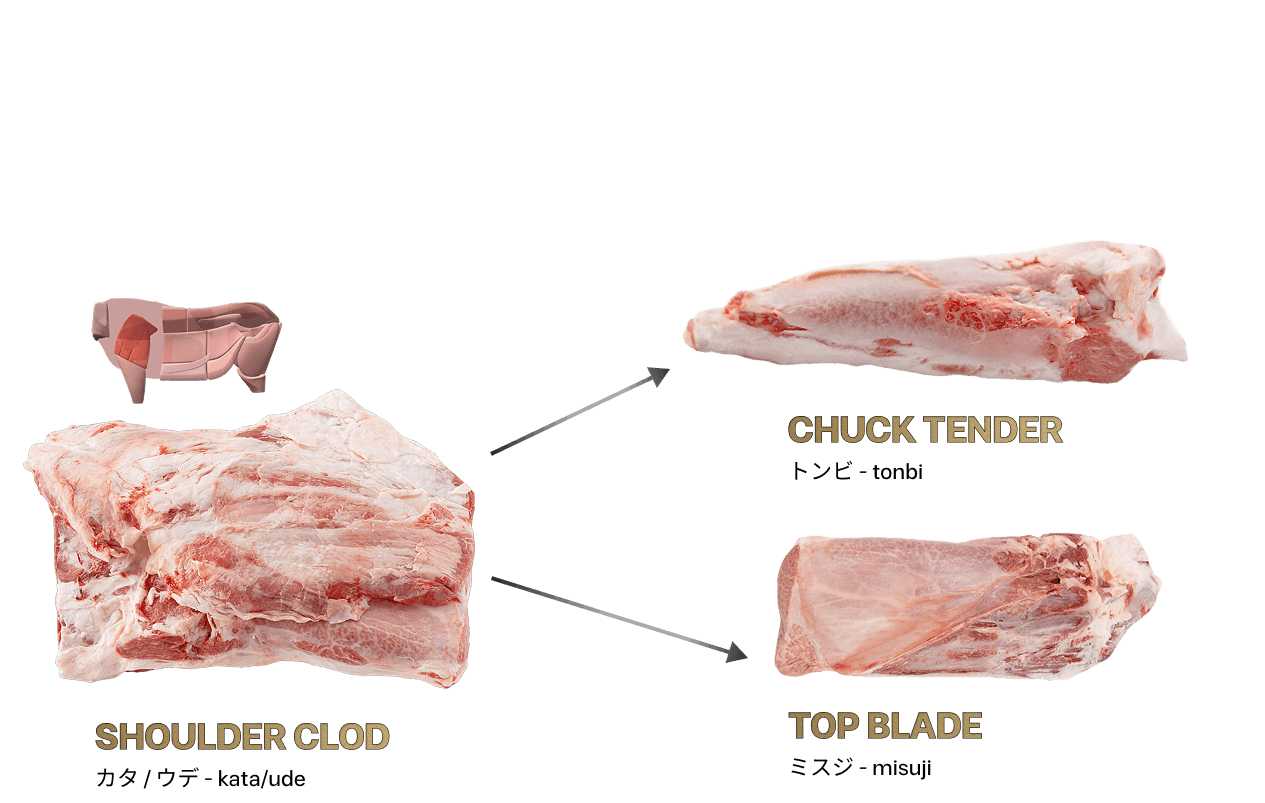
※ Location & Anatomy: Positioned in the forequarter shoulder region (Kata/Ude), adjacent to the Chuck Roll and Brisket, accounting for approximately 6.5% to 9.3% of total carcass weight.
※ Muscle Complexity: A well-exercised primal cut comprised of diverse sub-muscle groups ranging from firm, lean muscles to highly prized, ultra-tender rare cuts such as Top Blade (Misuji) and Chuck Tender (Tonbi/Togarashi).
※ Texture & Color: Features deep red muscle tissue rich in iron and amino acids, interwoven with fine spiderweb marbling (sashi) and collagen-rich connective tissue.
※ Flavor Profile: Delivers an intense, full-bodied beef umami combined with the subtle sweetness of Wagyu fat, offering a deep and satisfying flavor profile.
Recommended Dishes:
※ Sukiyaki & Shabu-shabu: Paper-thin slices simmered or swished in hot broth, creating a harmonious balance between deep lean-meat flavor and melting Wagyu fat.
※ Steak (Top Blade / Misuji Steak): Pan-sear thick cuts carved from Top Blade (Misuji) or Upper Oyster Blade over high heat to medium-rare for a melt-in-your-mouth texture.
※ Barbecue / Yakiniku: Sliced thin and grilled briefly over charcoal to render the fine marbling and release the sweet Wagyu aroma (Wagyu-ko).
※ Stewing / Beef Bourguignon & Gyu-don: Cubed for slow-cooking in stews and curries to dissolve natural collagen into rich gravy, or sliced thin for savory beef rice bowls (Gyu-don).
Characteristics:
※ Location & Anatomy: Located in the neck region at the frontmost section of the forequarter, situated directly ahead of the Chuck Roll (Katarosu).
※ Muscle Structure & Texture: A continuously exercised muscle group featuring coarse grain, firm red muscle, low fat content, and a high concentration of tendons and connective tissue.
※ Flavor Profile: Delivers an intensely concentrated, robust beef umami rich in natural collagen, which breaks down into savory gelatin upon cooking.
※ Processing & Utility: Ideal cut for trimming into stewing cubes (curry/stew) or mincing into ground meat to add deep beefy flavor to processed items.
Recommended Dishes:
※ Slow-Cooked Stews & Curries: Long-simmered in stews, curries, and soups (Nikujaga) to melt tough collagen into tender, gelatinous, rich gravy.
※ Hamburg Steaks & Patties: Ground finely or coarsely to exploit its deep lean-meat flavor and umami for juicy burgers and meatballs.
※ Minced Meat Sauces & Stir-Fries: Minced for meat sauces, pasta, Mabo Tofu, or taco fillings where robust beef flavor is required.
※ Broths & Soup Stock (Consommé): Simmered slowly over low heat to extract deep beef essence, gelatin, and rich stock bases.

※ Location & Anatomy: Positioned in the lower chest/breast section of the forequarter, situated beneath the Chuck Roll (Katarosu) and Shoulder Clod (Kata/Ude), spanning the rib cage.
※ Muscle Structure & Layering: Composed primarily of deep pectoral muscles featuring distinct, alternating layers of firm red muscle and rich, marbled fat.
※ Sub-cuts & Versatility: A large, highly versatile primal cut that can be sub-divided into celebrated specialty cuts, including Chuck Rib (Sankaku-Bara / King of Karubi), Brisket Flat (Burisuke), Brisket Skirt, and Brisket End Plate (Tenkaichi).
※ Flavor & Texture Profile: Delivers an intense, full-bodied beef umami combined with abundant sweet fat juices that render into rich, succulent gelatin when cooked.
Recommended Dishes:
※ Barbecue / Yakiniku: Carved into prime Karubi cuts (Sankaku-Bara / Burisuke) and grilled over charcoal to sear the outer fat into a caramelized, juicy crust.
※ Sukiyaki & Shabu-shabu: Paper-thin slices simmered in sweet soy broth or hot pot, allowing alternating fat-and-lean layers to melt into silky tenderness.
※ Gyu-don (Beef Rice Bowl) & Stews: Thinly sliced and simmered with onions for Japanese beef bowls (Gyu-don), or slow-braised in curries and stews to break down collagen.
※ Wagyu Bacon & Cured/Smoked Deli Cuts: Cured and smoked or sliced ultra-thin to capitalize on its rich, alternating fat-to-meat ratio.

Characteristics:
※ Location & Anatomy: Positioned in the lower leg regions of both forelegs (Fore Shank / Maesune) and hind legs (Hind Shank / Tomosune).
※ Muscle Structure & Texture: Heavily exercised muscles characterized by firm, lean red meat with low fat content, dense muscle fibers, and a high concentration of tendons and connective tissue.
※ Collagen Transformation: Exceptionally rich in natural collagen and protein, which slowly breaks down into silky, tender gelatin upon long-duration simmering, enhancing the texture and mouthfeel of broths and sauces.
※ Processing & Utility: Primary cut for slow-braising or for grinding into high-flavor minced meat (Koniku) for processed beef items.
Recommended Dishes:
※ Japanese Beef Curry & Stews: Slow-simmered in curries (Curry-rice), beef stews (Beef Bourguignon), and pot roasts until tough fibers dissolve into tender, fall-apart morsels.
※ Consommé & Rich Soups/Broths: Long-boiled over low heat to extract deep, robust beef umami, natural gelatin, and rich soup stock bases.
※ Hamburg Steaks & Meatballs: Ground finely or coarsely to contribute a deep, concentrated lean-beef flavor to burger patties, bolognese, and meatballs.
※ Braised Shank & Sausages: Braised slow-and-low in red wine or savory sauces, or minced for premium sausage and frankfurter production.

Characteristics:
※ Location & Anatomy: Positioned along the inner side of the lumbar spine beneath the sirloin/rib cage, representing only about 2% of the entire carcass weight, making it one of the rarest and most valuable primal cuts.
※ Muscle Structure & Sub-sections: Comprised of the psoas major muscle—the least exercised muscle on the animal—sub-divided from head to tail into Fillet A (head), Chateaubriand (center core), and Filet Mignon (tail).
※ Texture & Flavor: Delivers an impossibly tender, velvety, fine-grained texture with subtle, elegant marbling (sashi) that highlights the sweet, rich umami of lean Wagyu beef without feeling overly greasy.
※ Color Sensitivity: Features delicate muscle tissue that oxidizes and degrades in color rapidly upon exposure, requiring strict cold-chain handling and vacuum packaging.
Recommended Dishes:
※ Steak (Chateaubriand / Filet Mignon Steak): The premier preparation method; pan-sear thick cuts over high heat to rare or medium-rare for a melt-in-your-mouth bite.
※ Barbecue / Yakiniku: Cut into thick medallions or cubes and grill briefly over high heat/charcoal to lock in delicate juices without overcooking.
※ Roast Beef (Chateaubriand Roast): Oven-roast the trimmed whole center block under precise temperature control to preserve its silky, juicy center.
※ Sukiyaki, Shabu-shabu & Niku-sushi: Paper-thin slices dipped briefly in hot broth, or flash-seared over rice (Niku-sushi) and carpaccio for a light, luxurious dining experience.

Characteristics:
※ Location & Anatomy: Positioned in the center of the dorsal loin section between the Chuck Roll (Kata-rosu) and Sirloin (Saroin), spanning the 6th through 10th/11th thoracic ribs.
※ Muscle Composition: Comprised of two primary muscle groups: the tender, central Ribeye Log (Longissimus dorsi / Ribeye Core) and the highly marbled outer Rib Cap (Spinalis dorsi / Lifter meat / Ribcap).
※ Marbling & Texture: Features a thick, finely-grained texture infused with dense, web-like intramuscular marbling (sashi) that renders at low temperatures to deliver supreme tenderness and juiciness.
※ Flavor Profile: Known alongside Sirloin as a flagship luxury cut, releasing a sweet peach/coconut Wagyu aroma (Wagyu-ko) and deep, rich umami upon cooking.
Recommended Dishes:
※ Thick-Cut Steak (Ribeye Steak): Pan-sear thick cuts over medium heat to medium-rare/medium, allowing the abundant fat seams to render slowly without burning.
※ Sukiyaki: Paper-thin slices simmered in a sweet soy broth, allowing the rich marbled fat to envelop the tender meat fibers.
※ Shabu-shabu: Swished briefly in hot broth for a silky, melting mouthfeel with a clean.
※ Barbecue / Yakiniku & Roast Beef: Sliced thin for quick tableside grilling, or oven-roasted as a whole trimmed block under controlled heat to lock in natural juices.
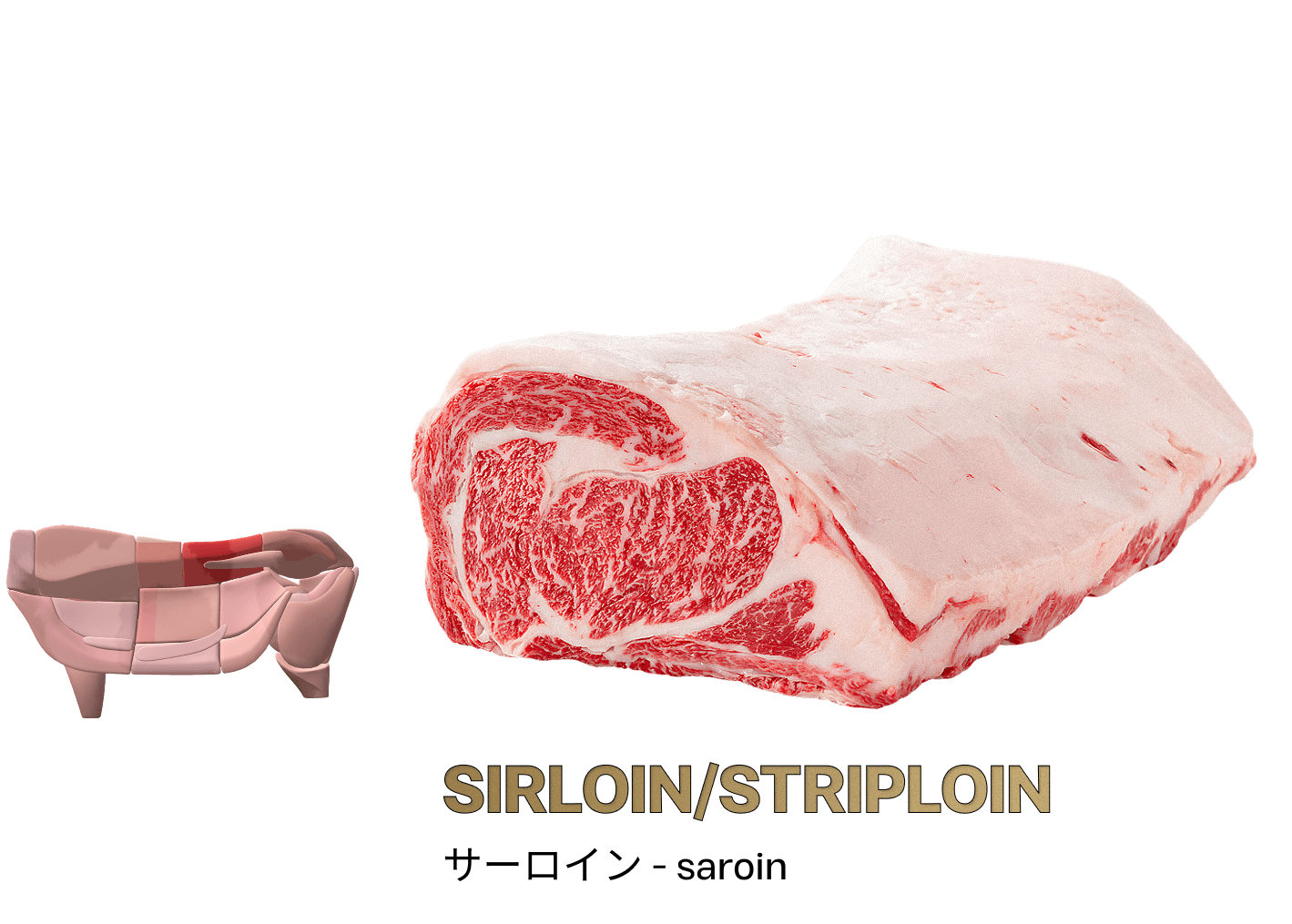
Characteristics:
※ Location & Anatomy: Positioned in the lower loin section along the dorsal spine, extending from the 11th rib to the last lumbar vertebra, sitting between the Ribloin (Ribeye) and Rump (Momo), accounting for approximately 7.0% of the carcass weight.
※ Structure & Texture: Features finely-textured, velvety red muscle (longissimus dorsi) with a moderate back fat cap along one edge, holding its shape exceptionally well for uniformly sized cuts.
※ Marbling & Flavor: Possesses rich, buttery, and impeccably uniform marbling (sashi) that renders at low temperatures to create a delicate melt-in-your-mouth texture.
※ Sensory Profile: Releases a sweet peach/coconut aroma (Wagyu-ko) and deep, savory umami richness upon cooking, making it widely acclaimed as the "King of Steaks".
Recommended Dishes:
※ Steak (Sirloin / Striploin Steak): Pan-sear thick cuts (1.5–2.0 cm) over high heat to medium-rare for a rich, juicy crust and tender center.
※ Barbecue / Yakiniku / Yaki-shabu: Slice thinly (3–5 mm) and grill briefly over charcoal to unleash the sweet fat aroma.
※ Sukiyaki: Cut into paper-thin slices (1.5–2.0 mm) and simmer in sweet savory broth, allowing the marbled fat to embrace the tender meat.
※ Shabu-shabu / Roast Beef: Swish thin slices briefly in hot broth, or roast the whole trimmed block under controlled heat to lock in sweet juiciness.

Characteristics:
※ Location & Anatomy: Positioned in the upper section of the short plate (Tomobara), situated directly beneath the ribloin/sirloin and extending above the lower short plate (Sotobara).
※ Muscle Structure & Sub-cuts: Comprises the upper abdominal wall muscles, which can be further sub-divided into highly coveted specialty cuts including Head Rib (Head-bara), Short Rib Core (Nakabara-shin), Intercostals (Rib Fingers / Naka-ochi), and Flap Meat (Kainomi).
※ Texture & Marbling: Characterized by robust, coarser muscle fibers interleaved with dense, web-like intramuscular fat (sashi) that renders effortlessly under heat.
※ Flavor Profile: Delivers an intensely concentrated, deep beef flavor combined with rich, sweet fat juiciness, serving as a primary source for high-end Karubi selections.
Recommended Dishes:
※ Barbecue / Yakiniku (Special/Prime Karubi): Slice into strips or rectangular tiles (Head-bara / Nakabara) and flash-grill over high charcoal heat for a caramelized, buttery bite.
※ Steak (Flap Meat / Kainomi Steak): Pan-sear thick cuts carved from Flap Meat (Kainomi) to medium-rare for a melt-in-your-mouth steak experience.
※ Sukiyaki & Shabu-shabu: Slice paper-thin to allow the rich fat seams to dissolve smoothly into savory broth, enveloping the tender meat fibers.
※ Slow-Cooked Stews & Rib Finger Skewers: Simmer Intercostals (Rib Fingers / Naka-ochi) in curries and stews to break down connective tissue into rich, savory gravy, or grill on skewers.

Characteristics:
※ Location & Anatomy: Positioned in the lower section of the Short Plate primal (Tomobara / belly area), located directly beneath the Upper Plate/Short Rib (Nakabara).
※ Muscle Structure & Sub-cuts: Comprises the outer abdominal muscles (rectus abdominis, external oblique), sub-divided into celebrated specialty cuts: Short Plate core (Tatebara), Flank Steak (Frank / Sasami), and Inside Skirt.
※ Texture & Marbling: Features thick, well-proportioned layers of juicy lean muscle and rich Wagyu fat (sashi), offering a substantial, flavorful, and tender texture.
※ Flavor Profile: Delivers an intensely rich, sweet fat flavor (Wagyu-ko) and deep belly umami that caramelizes beautifully when exposed to heat.
Recommended Dishes:
※ Barbecue / Yakiniku: Thinly sliced into classic Karubi strips (Tatebara / Frank) and flash-grilled over high charcoal heat for a smoky, caramelized, buttery bite.
※ Sukiyaki & Shabu-shabu: Paper-thin slices cooked briefly in hot broth, allowing the alternating fat-and-lean belly layers to melt into silky tenderness.
※ Gyu-don (Japanese Beef Bowl): Thinly sliced and simmered with onions in savory-sweet soy sauce, infusing rich beef fat and deep umami into the rice bowl.
※ Slow-Cooked Stews & Curries: Cubed or braised in curries, beef stews, and soups to dissolve fat seams and collagen into rich, savory gravy.
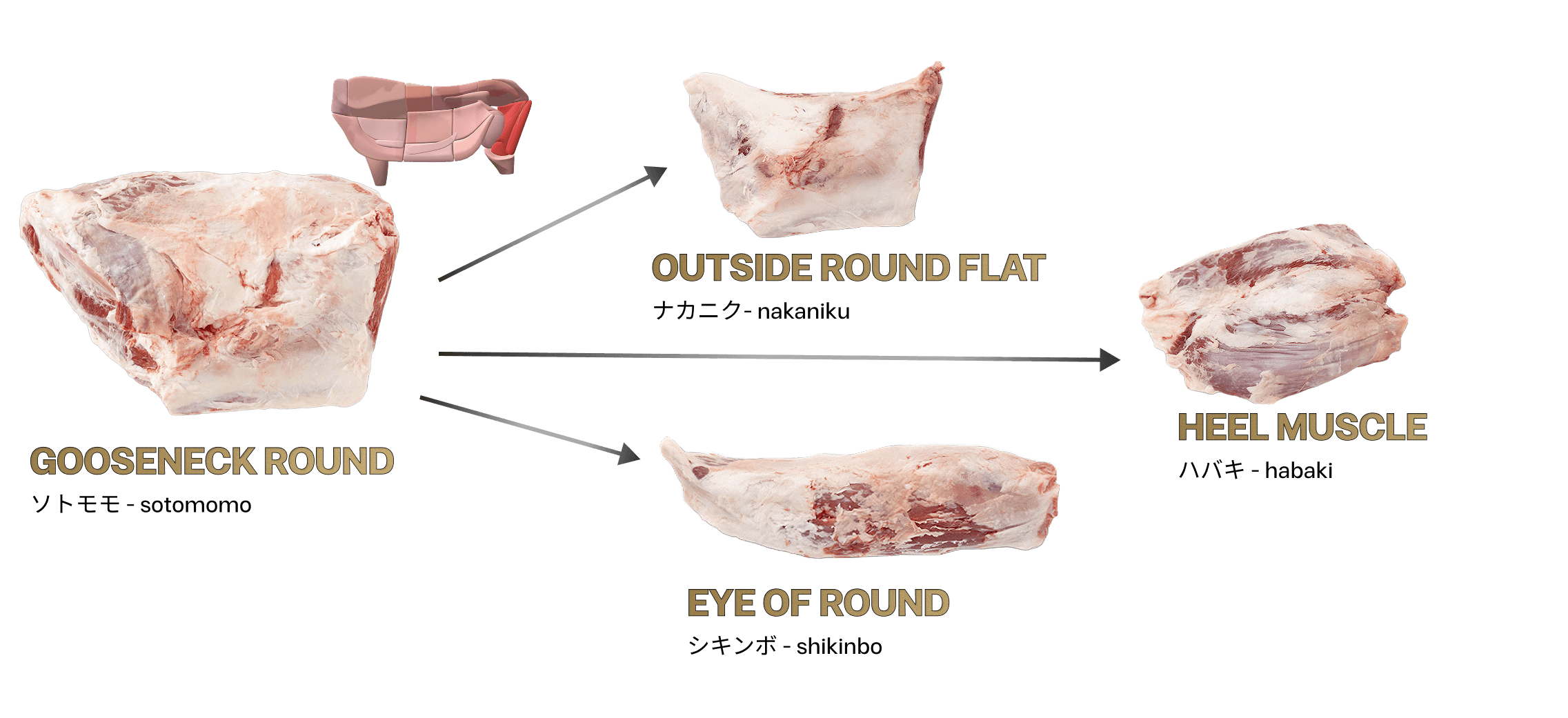
Characteristics:
※ Location & Anatomy: Positioned in the outer hind leg/thigh section of the Round primal (Momo), located adjacent to the Top Round (Uchimomo) and Knuckle (Shintama).
※ Sub-cuts & Anatomy: Comprised of three distinct muscle sections: Outside Round / Round Flat, Eye of Round (M. semitendinosus), and Heel (M. flexor digitorum superficialis).
※ Texture & Structure: A heavily-muscled, well-exercised lean cut characterized by firm, coarse muscle fibers, a tighter texture, and a high proportion of lean red muscle (Akami).
※ Flavor Profile: Delivers a light, clean, and savory beef umami rich in natural iron, making it an ideal choice for guests who prefer flavorful lean beef over heavy fat marbling.
Recommended Dishes:
※ Roast Beef: Oven-roast the whole trimmed block at controlled low temperatures, producing a juicy, clean-tasting roast slice that is light and digestible.
※ Sukiyaki & Shabu-shabu: Paper-thin slices cut strictly perpendicular to the muscle grain, cooked briefly in hot broth for a light, tender mouthfeel.
※ Barbecue / Yakiniku: Sliced thin and flash-seared over high charcoal heat for a quick, savory lean-beef bite.
※ Stews, Curries & Poached Beef: Slow-simmered in curries and stews to tenderize firm muscle fibers, or flash-poached in hot oil/savory broth.

Characteristics:
※ Location & Anatomy: Positioned on the inner thigh of the hind leg (Hindquarter), adjacent to the D-Rump (Ranichi), Gooseneck Round (Sotomomo), and Knuckle (Shintama); comprised of the Top Round Cap (Uchimomo-kaburi / M. gracilis), Top Round Cap Off / Main Muscle (Uchimomo-hontai / M. semimembraneceus & M. adductor magnus), and a small tender section (M. pectineus & M. sartorius).
※ Muscle Structure & Marbling: The largest lean primal cut in the hind leg, with long, rounded muscle fibers and fine, balanced marbling (sashi) within dense red muscle tissue (Akami).
※ Tenderness Gradient: Tenderness varies across the primal—sections near the Knuckle are tender, while those toward the Gooseneck Round have slightly more fat and a firmer grain.
※ Flavor Profile: Delivers a clean, light, highly digestible umami rich in natural iron and amino acids, with a satisfying lean flavor without an overly greasy mouthfeel.
Recommended Dishes:
※ Roast Beef: Oven-roast trimmed whole blocks (cap off) at controlled temperatures for juicy, lean slices.
※ Sukiyaki & Shabu-shabu: Slice paper-thin across the grain and briefly swish in hot broth for a light, tender bite.
※ Steak (Top Round Steak): Pan-sear thick-cut steaks from the tender inner section to rare or medium-rare for juiciness.
※ Barbecue / Yakiniku & Stir-Fry: Flash-sear thin slices over high charcoal heat (Yakiniku) or stir-fry to highlight its savory lean flavor.

Characteristics:
※ Location & Anatomy: Positioned in the hindquarter rump section between the Sirloin (Saroin) and Gooseneck Round (Sotomomo); divided into two primary sub-cuts: Sirloin Butt (Rampu) running into the sirloin, and Top Sirloin Cap / Culotte / Picanha (Ichibo) extending toward the round.
※ Texture & Tenderness: Celebrated as the most tender muscle group among the Round/hip primal cuts due to its position adjacent to the Sirloin, featuring finely-textured, velvety muscle fibers.
※ Marbling & Appearance: Displays vibrant, attractive red muscle tissue infused with finely distributed, well-proportioned marbling (sashi) that delivers succulent juiciness without feeling overly greasy.
※ Flavor Profile: Offers a rich, mellow, and elegant beef flavor in the Sirloin Butt (Rampu), balanced by the deeper, robust beefiness and sweet fat aroma (Wagyu-ko) of the Top Sirloin Cap (Ichibo).
Recommended Dishes:
※ Steak (Rump / Sirloin Butt / Ichibo Steak): Pan-sear thick cuts (Gluteus medius or Ichibo) over high heat strictly to rare or medium-rare for a rich, juicy, and tender bite.
※ Roast Beef: Oven-roast trimmed whole blocks (Ranichi / Ichibo) at low temperatures to lock in sweet beef juices while maintaining a velvety center.
※ Barbecue / Yakiniku: Slice thinly or cut into cubes and flash-grill over high charcoal heat to render the fine fat seams and release the sweet Wagyu aroma.
※ Carpaccio & Diced Steak / Skewers: Flash-sear thin slices for Italian-style Carpaccio or Niku-sushi, or cut into skewers/Diced Steaks to showcase its balanced lean-meat profile.

Characteristics:
※ Location & Anatomy: Positioned in the lower hind leg thigh section of the Round primal (Momo), located at the base of the hind leg around the knee/femur joint; spherical in shape (Shintama / Maru) and accounting for approximately 6.2% of carcass weight.
※ Sub-cuts & Muscle Diversity: A versatile primal cut sub-divided into 4 distinct muscles: Tri-tip (Tomosankaku / Hiuchi), Knuckle Center (Shin-shin / Marushin), Outside Knuckle / Turtle Round (Kamenoko), and Inside Knuckle / Knuckle Cap (Marukawa).
※ Texture & Marbling Gradient: Features a predominantly lean red meat structure (Akami) with a wide marbling spectrum - ranging from the intensely marbled Tri-tip (Tomosankaku) and velvety, fine-grained Knuckle Core (Shin-shin) to the lean, finely-fibered Kamenoko and Marukawa.
※ Flavor Profile: Delivers a deep, savory beef umami rich in natural iron and amino acids, balanced by a light, sweet Wagyu fat aroma (Wagyu-ko) that provides a clean, non-greasy dining experience.
Recommended Dishes:
※ Steak (Shin-shin / Tomosankaku Steak): Pan-sear thick cuts carved from Shin-shin or Tomosankaku over high heat strictly to rare or medium-rare for a juicy, tender bite.
※ Roast Beef (Shin-shin Roast): Oven-roast trimmed round blocks (Shin-shin) at low controlled temperatures to create elegant, uniform lean roast slices.
※ Barbecue / Yakiniku: Thinly slice Tomosankaku (Yaki-sukiyaki cut) or Kamenoko and flash-sear briefly over high charcoal heat for a smoky, melt-in-your-mouth or savory lean bite.
※ Sukiyaki & Shabu-shabu: Slice paper-thin perpendicular to the grain, swishing briefly in hot broth for a silky, light, and digestible hot pot dish.